Research on the Application of Aerogel-Based Thermal Insulation and Energy-Saving Materials in Buildings
- Share
- publisher
- MAX
- Issue Time
- Jan 27,2026
Summary
The building sector consumes significant energy, making efficient insulation crucial. Aerogels, with ultra-low thermal conductivity, high porosity, and low density, offer excellent insulation. This paper reviews their structure, performance, and applications, discusses challenges such as fragility, moisture sensitivity, and cost, and proposes strategies to expand their use in sustainable, energy-efficient buildings.
Global Energy Consumption and the Background of Building Energy Use
The continuous growth of global energy consumption has led to a series of environmental challenges, including increased greenhouse gas emissions, intensified climate change, and resource depletion. The building sector is one of the largest energy-consuming industries worldwide, accounting for more than 40% of global total energy consumption. According to statistics from the International Energy Agency (IEA), building heating alone accounted for approximately 15%–20% of global primary energy supply between 2017 and 2022.
As global climate change and energy crises become increasingly severe, the issues of high energy consumption and carbon emissions in the building sector have drawn significant attention from governments and research institutions worldwide. The European Union proposed in the Energy Efficiency Directive that energy efficiency should be improved by at least 32.5% by 2030. The United States promotes the application and dissemination of energy-efficient building technologies through the Energy Policy Act. In China, the Green Building Action Plan clearly requires newly constructed buildings to meet energy-efficiency standards while actively promoting energy-saving retrofits for existing buildings.
Performance Requirements of Thermal Insulation Materials for Building Energy Efficiency
To achieve building energy efficiency, the selection of insulation materials is of critical importance. Such materials must meet a range of key performance requirements, including low thermal conductivity (≤ 0.035 W/(m·K)), excellent fire resistance, reliable mechanical strength, and good durability and moisture resistance, in order to withstand complex and variable service conditions.
However, traditional building insulation materials—such as rock wool, glass wool, polyurethane foam boards, and extruded polystyrene (XPS) boards—although offering certain advantages in thermal insulation, lightweight characteristics, and cost, are prone to degradation under long-term exposure to moisture, ultraviolet radiation, high temperatures, and chemical corrosion. These factors lead to a decline in thermal performance and durability, making it difficult for conventional materials to meet the long-term energy-saving requirements of modern buildings.
Structural Characteristics and Thermal Insulation Advantages of Aerogel Materials
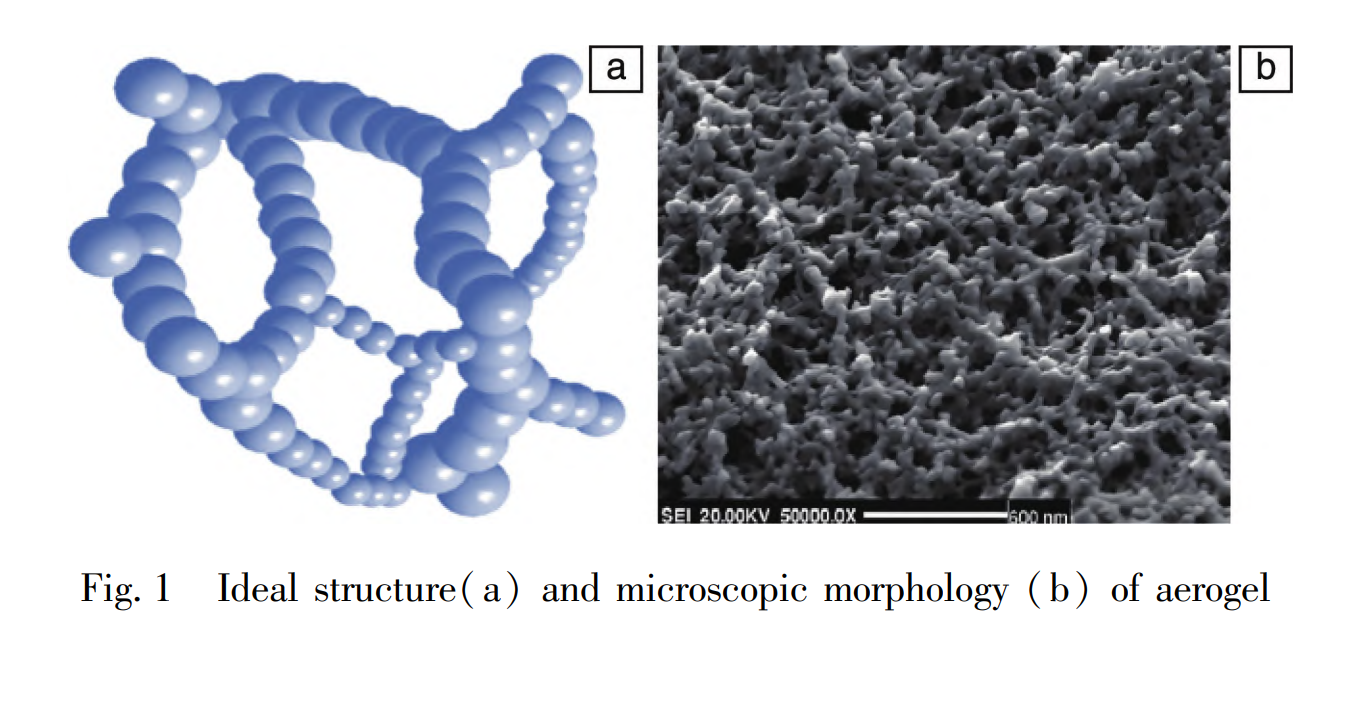
Aerogels are a new class of lightweight porous materials that have been widely applied in thermal insulation, sound insulation, adsorption, energy storage and conversion, and biomedical fields. Their structure consists of nanoscale particles or polymer molecular chains interconnected in a three-dimensional network, forming a highly porous nanostructure. This unique structure endows aerogels with an extremely high specific surface area (up to 1000 m²/g) and porosity exceeding 90%, making them among the lightest solid materials known.
The gaseous dispersion medium within the nanopores effectively suppresses heat conduction and low-temperature infrared radiation. As a result, aerogels can achieve an ultra-low thermal conductivity of as low as 0.013 W/(m·K) at room temperature, demonstrating outstanding thermal insulation performance.
Application Progress of Aerogels in the Field of Building Energy Efficiency
With the increasing demand for low-carbon and environmentally friendly solutions in the construction industry and the continuous advancement of aerogel research, aerogels have become a major research focus in the field of building energy efficiency. In recent years, various aerogel-based building materials have been developed, including aerogel composite insulation panels, flexible aerogel blankets, and transparent aerogel glazing. These materials exhibit multifunctional advantages such as thermal insulation, sound insulation, and flame retardancy, meeting diverse requirements for high energy efficiency, structural safety, and enhanced indoor comfort.
Challenges and Future Development Directions of Aerogel Applications in Buildings
Nevertheless, the widespread integration of aerogels into the construction industry still faces several challenges. Aerogels are inherently brittle and possess limited mechanical strength, making it difficult for them to independently withstand mechanical loads in complex building environments. In addition, their relatively high moisture absorption can lead to gradual degradation of thermal insulation performance under humid conditions. Furthermore, high production costs, technical barriers to large-scale manufacturing, high energy consumption during production, and inadequate waste management throughout the material life cycle pose challenges to sustainable development.
These issues represent key directions for current research and provide critical support for improving aerogel performance and expanding its application in the construction sector. This paper systematically introduces the types and properties of aerogel materials for building applications, reviews recent research progress and energy-saving applications of aerogels in building insulation, and discusses the potential challenges and future development directions of aerogels in the construction industry, with the aim of contributing to building energy conservation, emission reduction, environmental protection, and sustainable development.
GOMIN aerogel coating delivers ultra-low thermal conductivity, fire resistance, and long-term durability, making it perfect for energy-efficient walls and roofs. Lightweight, easy to apply, and compatible with multiple substrates, it helps reduce energy costs and enhance comfort.
Want to learn how GOMIN can upgrade your building"s insulation? Follow us or leave your contact below for a tailored solution.